
When Is the Right Time to Replace Your Windows?
Drafts, condensation and rising bills are all quiet signals worth acting on early.
The sequence you choose can protect your panels, your roof and your investment. Here is why a proper roof survey always comes before a photovoltaic design.
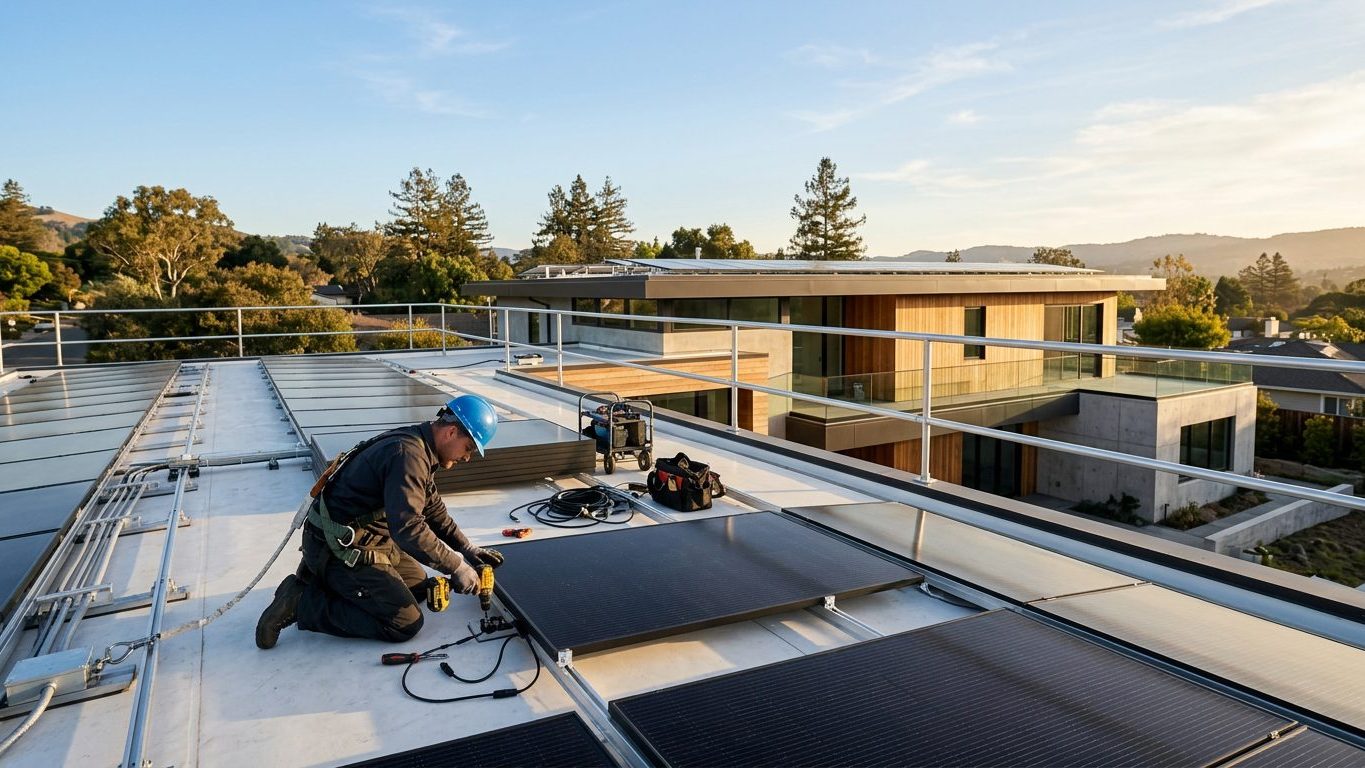
Solar has become far easier to install than it used to be, and the technology has improved to the point where a well designed array on a suitable roof is a genuinely sensible investment for many households. What has not changed, however, is the fact that the panels live on a roof — and that makes the order in which you do things more important than most people realise.
We are regularly asked whether a roof can be replaced after a solar installation, and the honest answer is that it is possible but never ideal. Every panel has to come off, the roofing work has to be completed, the flashing has to be made good around the penetrations, and then everything goes back on. It is expensive, it takes time, and it leaves opportunities for mistakes that are expensive to correct later.
Getting the sequence right, by contrast, turns two projects into one. The roof is surveyed, prepared and finished properly, and the array is designed around the finished surface rather than the existing one. The result is a cleaner installation, a tidier roof line and a system that will not need to be disturbed.
Before anyone talks about how much power an array can produce, the roof itself needs an honest assessment. We look at the covering and its age, the condition of the sheathing underneath, the flashing around chimneys and penetrations, the state of the valleys, and the ventilation in the attic.
Ventilation deserves particular attention. A great deal of energy can be lost through a poorly ventilated attic, and no photovoltaic system will perform as expected if the roof structure is spending the winter damp. A roof replacement is a natural opportunity to address soffit, ridge and intake ventilation while the structure is already open.
Homeowners often ask how long a roof lasts, and the frustratingly honest answer is that age tells you very little on its own. A roof can look mature and be entirely sound, or it can look tidy and be hiding serious problems beneath. The covering matters, the installation quality matters, the exposure matters, and the maintenance history matters more than any of them.
The signs that deserve attention are more practical than visual. If daylight is visible in the attic, if there is staining or damp on the underside of the decking, if granules are collecting in the gutters, or if shingles are lifting and cracking, the roof is telling you it needs work regardless of how recently it was installed.
When both are happening at once, the coordination is straightforward but it is not automatic. The array has to be laid out around the roof planes rather than forced into awkward leftovers. Flashing at every penetration has to be integrated with the roofing membrane properly rather than surface-mounted on top of it. Cables need a protected route into the building.
The electrical side deserves the same attention. Panels generate direct current, and that has to be converted, conditioned and routed correctly through the home's distribution panel. In an older home the panel itself may need attention before it can safely carry an additional load, and it is far better to discover that during the survey than halfway through the installation.
A solar array generates power across the middle of the day, which is often not when a household uses most of its electricity. A battery changes that picture by allowing energy to be stored for the evening peak or held for a cloudy day. Whether that makes financial sense depends on how your household actually uses power and on the tariff you are on.
This is worth modelling properly before committing. A design that is wrong for your consumption pattern will underperform no matter how efficient the individual components are, and a modest, correctly sized system that fits your usage is far more useful than an oversized one that produces surplus you never use.
Commissioning is where a good installation proves itself. The system should be set up, monitored and explained to you before the crew leaves. You should know what the monitoring shows, how to read it, what happens during an outage, and who to call if something stops behaving as expected.
Keep the documentation. Permits, the panel and inverter details, the utility correspondence and the workmanship warranty all belong in one folder, because the moment you need them is rarely the moment you can find them. A well kept file turns a potentially frustrating conversation into a quick one.
If you already have solar, have the roof inspected with the array in mind. If you are considering solar and your roof is due for work, do the roof first. Either way, the principle is the same: the roof is the surface everything else depends on, so it should be right before anything is mounted to it.
The roof is the surface everything else depends on — so it should be right before anything is mounted to it.
Nova House GroupA roof that is sound underneath and properly ventilated will protect the array for its whole life. A roof that is not will force you back up there far sooner than you expect.
Solar and roofing sit in the same Nova House Group service family, which means one team can survey, plan and deliver both in a single coordinated schedule. If you would like to know whether your roof is ready, or what a combined project would involve, contact our Sacramento office and we will arrange a site visit at no cost.
Practical guidance on caring for, improving and protecting your home.
Drafts, condensation and rising bills are all quiet signals worth acting on early.
The sequence you choose can protect your panels, your roof and your investment.

Layout before tile, storage before taps, ventilation before finishing.